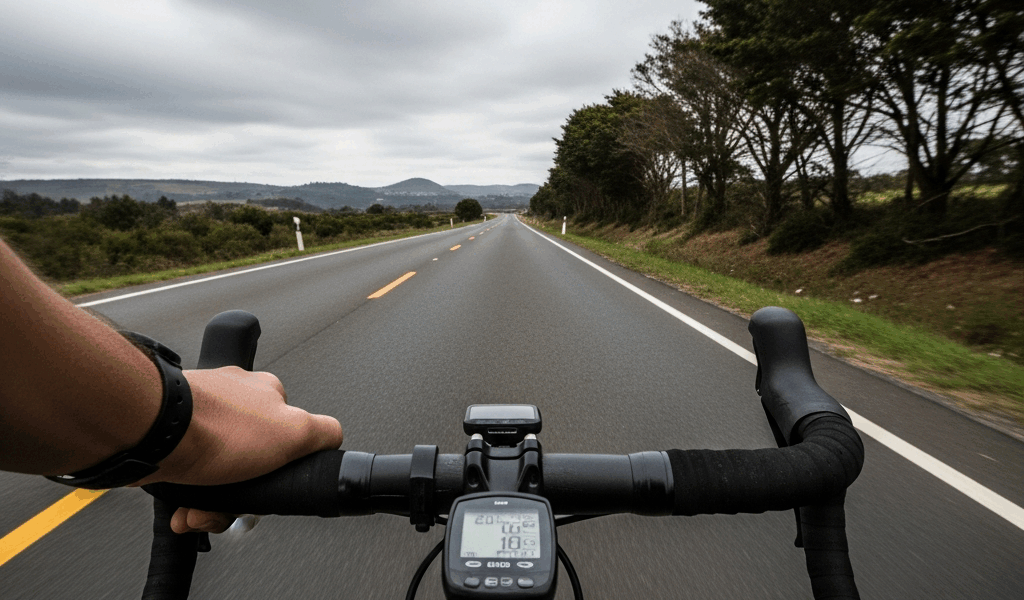
The Gap Is Real — and No, You’re Not Imagining It
Cycling speed has shifted noticeably with all the indoor training noise flying around. If you’re pulling 22 mph averages on Zwift and then crawling at 19 mph on actual pavement, something feels broken. It’s not. The two environments are genuinely, fundamentally different — and pretending otherwise is exactly how riders end up demoralized before a gran fondo they should be confident about. Once you understand what’s actually causing the gap, you can stop blaming your lungs and start using both numbers for what they’re worth.
Four Things to Check Before You Blame Your Fitness
Rolling Resistance Is a Completely Different Animal Outdoors
But what is rolling resistance, really? In essence, it’s the friction your tires create as they deform against a surface. But it’s much more than that. A Wahoo Kickr or Tacx NEO calculates it mathematically — clean, tidy, consistent. Real asphalt doesn’t care about your trainer’s algorithm. Wet roads, chip seal, gravel, a freshly laid tarmac patch — each one fights back differently with every pedal stroke.
I learned this firsthand after three months of winter indoor sessions. Went out on a 28mm Continental GP5000 inflated to 68 psi when it should have been 82 psi. Couldn’t figure out why I felt like I was riding through sand. Save yourself the trouble I had. Check your tire pressure before every outdoor ride. A tire at 85 psi rolls measurably faster than one sitting at 65 psi — we’re talking real speed, not marginal gains. Worn tread adds drag on top of that. If your outdoor rubber hasn’t been touched since October, that 3 mph gap makes complete sense.
Wind and Elevation Don’t Negotiate the Way Zwift Does
Zwift has a wind model. It’s real. It’s also optional, and most riders casually leave it running at 50% strength without thinking twice. A 15 mph sustained headwind on open farmland doesn’t offer a slider. It drops your speed 4–6 mph on flat terrain whether you like it or not. That’s what makes outdoor riding both humbling and endearing to us road cyclists — the conditions are honest.
Elevation is trickier. Zwift pulls real course data for places like Watopia and Richmond. The grade percentages are accurate. But watching a 6% climb tick by on a screen and actually grinding your 172.5mm cranks against that grade with 18 lbs of bike underneath you — those are different experiences entirely. Your legs know. Review your outdoor route’s elevation profile and the wind data from the day you rode. Use a bike speed calculator. If you faced a headwind for 40% of the route and climbed 1,200 feet, a 2–3 mph drop is expected math, not a fitness collapse.
Trainer Power and Road Power Often Disagree — By a Lot
Worth flagging before going further. A Stages crank arm or a pair of Favero Assioma Duo pedals measures your actual leg output. Strain gauges, real deflection, real watts. A trainer estimates power based on resistance settings and wheel speed. The math is solid in theory. In practice, the two systems routinely disagree by 5–15%. Rode 250W on your Kickr Core last Tuesday? Your Assioma pedals might read 218W at identical perceived effort outdoors.
I’m apparently one of those riders where the gap sits around 9–11%, and my Kickr works for me while my Garmin Rally pedals never match it exactly. That’s just how it is. The trainer isn’t lying — its power curve, the relationship between flywheel speed and applied resistance, simply doesn’t account for your specific crank length, your chain wear, or your drivetrain friction. A worn 11-speed chain on a Shimano 105 groupset loses real watts that the trainer never sees.
Compare a recent outdoor power file against indoor data from a similar effort level. If your trainer reads 8–10% high consistently, stop using those trainer watts to validate outdoor speed. Use your outdoor power as the honest baseline. Build your pacing zones around real numbers.
Pacing Falls Apart the Moment Real Life Intervenes
Indoors, the Zwift route is fixed. The road is a rail. Other riders’ power zones float on the screen and you chase them or match them — it’s almost frictionless from a pacing standpoint. Outdoors, you coast at a red light on Elm Street for 45 seconds. You soft-pedal around a pothole you spotted at the last second. A crosswind pushes you sideways through an exposed valley and you unconsciously back off 30 watts to hold your line.
Pull up your outdoor power file and look at how jagged it is. Then look at an indoor file from a comparable effort. Indoor power is a nearly flat line. Outdoor power looks like a seismograph during an earthquake. Those constant dips and surges lower your average speed even when your threshold power hasn’t moved an inch. You’re not weaker. You’re just navigating an environment that doesn’t cooperate.
Why Indoor Training Flatters Your Speed Expectations
Trainers are speed-flattering machines. ERG mode is the main culprit. Electronic resistance adjusts automatically to hold you at a target wattage regardless of cadence — spin at 82 rpm or grind at 96 rpm, the trainer keeps you pinned at 280W either way. That’s genuinely powerful for building specific power adaptations. But it also trains a narrow skill. Real roads demand constant micro-adjustments: accelerating into a 4% ramp, feathering effort over a false flat, surging 15 watts around a slower rider. ERG mode doesn’t prepare your neuromuscular system for any of that.
Zwift’s descents are also suspiciously kind. The simulation removes mechanical vibration, crosswind buffeting, and the cognitive load of braking and line selection at 38 mph. You recover faster than you would on an actual descent. That recovery time quietly inflates your overall average in ways that simply don’t transfer to pavement.
A 20-minute indoor interval at 300W average feels like 300W because nothing interrupts it. That same effort outdoors — real wind, real terrain variance, real traffic — might produce 283W average with frequent dips to 260W through transitions. Your outdoor speed reflects that honest work. Not the flattery of a resistance algorithm running in your spare bedroom.
What Your Outdoor Numbers Actually Tell You About Race Day
Training for a century or a gran fondo? Your outdoor speed data is incomparably more useful than anything your trainer produces. A 100-mile event isn’t ridden in ERG mode. All four factors above hit you simultaneously for six or seven hours. Your honest 19 mph outdoor average is a far better predictor of event-day pacing than a Zwift 22 mph that was generated inside a controlled bubble.
Use outdoor rides to set realistic targets. Averaging 18–19 mph on hilly terrain with variable wind? Target 17–18 mph for your century, not 20. That margin accounts for fatigue at mile 68, the six-minute stop at aid station three, and the mental weight of endurance riding late in a long effort. Honest pacing prevents the bonk that catches riders who believed their trainer told them the whole truth.
Practical Ways to Close the Gap
So, without further ado, let’s dive in.
First, you should get outside more frequently — at least if you have an event on the calendar within 12 weeks. Aim for two outdoor rides per four-week block instead of defaulting to one. Your neuromuscular system adapts to variable effort faster than your ego adapts to slower average speeds. Give it the stimulus it needs.
Outdoor ride data might be the best option for calibrating pacing zones, as real-world training requires real-world reference points. That is because trainer-based zones carry that 5–15% power discrepancy baked right in. If your outdoor sweet spot holds at 238W with an 18 mph average on rolling terrain, use that as your event-pacing anchor. Forget the 262W benchmark your Kickr told you about.
While you won’t need a completely new training structure, you will need at least one uncontrolled-terrain ride before any major event. Gravel paths, potholed back roads, a hilly loop with exposed sections. The speed is irrelevant. The adaptation is everything.
And stop stacking your outdoor average against your trainer average like they’re measuring the same thing. They’re not. Your trainer builds power. Your outdoor rides reveal how you’ll deploy that power when conditions don’t cooperate. Both are necessary. Neither replaces the other. When you accept the gap as useful information rather than evidence of failure, your 19 mph outdoor average stops feeling disappointing — and starts feeling like the honest data that gets you across a finish line fueled, paced correctly, and confident.



Stay in the loop
Get the latest cycling events today updates delivered to your inbox.