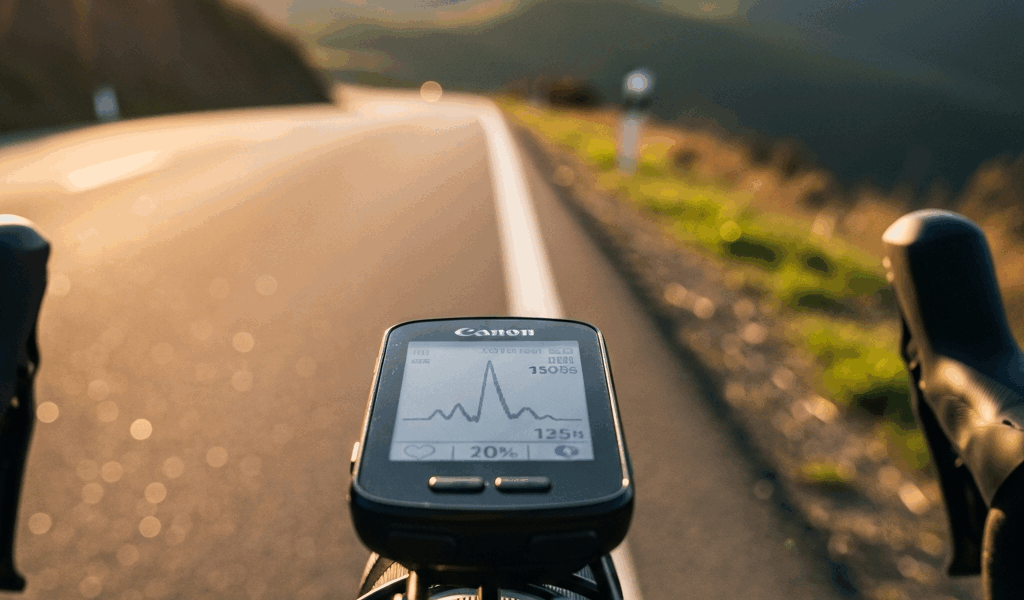
Why Your Heart Rate Spikes on Climbing Segments
Climbing heart rate has become harder to navigate with all the conflicting advice flying around. Train more. Breathe better. Lose weight. Build your base. None of it addresses what’s actually happening when your monitor jumps 25 beats the second the road tilts up.
As someone who spent three seasons chasing fitness on hilly terrain, I spent months getting comfortable with HR spikes on climbs — the hard way, mostly. Today, I will share it all with you.
Spoiler: it probably isn’t a cardio problem. It’s a diagnostic signal. Your body is telling you something specific about pacing, cadence, or what you did (or didn’t) eat before the climb started. Once I figured that out, the spikes became predictable. Manageable. Sometimes even preventable.
What a Normal HR Spike Actually Looks Like
But what is a “normal” climbing HR response? In essence, it’s a gradual rise that stabilizes. But it’s much more than that.
On a steady 3–5 minute climb at controlled effort, you enter near your sustainable threshold pace. Heart rate climbs for the first minute or so, then levels off. By the top, you’re maybe 8–12 BPM above your flat-road cruising HR for equivalent watts. That’s it. That’s normal.
The spike that concerns me looks different. You hit the base, and within 30–45 seconds your HR jumps 20+ BPM above what the grade should demand. Breathing goes ragged. You feel like you’re redlining at 40% of the climb. Worse — your HR doesn’t drop cleanly after you crest. It hangs there, elevated, for several minutes.
If that’s your pattern, one of four things is happening. And you can actually diagnose which one.
You Attacked the Base Too Hard
This is the most common culprit. Worth mentioning before anything else. It’s where 70% of climbers go wrong — including me, for two full seasons.
Here’s what happens: you enter slightly too hard, maybe 5–10% over threshold. Your muscles demand oxygen faster than your aerobic system can deliver it. Oxygen debt accumulates fast. Your cardiovascular system responds by cranking heart rate upward — hard — trying to compensate. What feels like an “unexplained” spike is actually a predictable emergency response to an unsustainable entry pace.
Then the panic sets in. You feel the spike, you back off hard, your HR swings wildly, and your legs fill with concrete. That yo-yo pattern is almost always self-inflicted.
The fix is mechanical, not motivational. Establish a hard HR ceiling before you start the climb. If your sustainable threshold sits around 165 BPM, enter a known climb at 155–158 BPM. Use the first 20 seconds to feel out the grade and settle your rhythm. It will feel conservative — almost embarrassingly easy. That feeling is exactly the point. You’re building a sustainable ramp instead of triggering an emergency response.
One more thing: on race day, adrenaline will make 165 BPM feel like 155. Your perceived effort is lying to you. The HR ceiling matters more than feel when cortisol is involved. Lock the number in before the climb starts, not during it.
Your Cadence Collapsed and Your Body Paid for It
Cadence collapse is insidious. It doesn’t feel like a problem — it feels stronger. That’s what makes it so dangerous to cyclists who train mostly on flat routes.
When you drop into a big gear and grind uphill at 55–60 RPM, your legs feel engaged. Powerful, even. What’s actually happening is that your neuromuscular system is generating high force at low cadence — which demands enormous amounts of oxygen and glucose per muscle fiber. Your cardiovascular system compensates. Heart rate spikes to cover the inefficiency.
The threshold for most riders is roughly 70–85 RPM. Below 70, your HR cost per watt climbs sharply. I learned this the hard way at Gravel Worlds 2022, on a 12% pitch outside of Lincoln. I was apparently a chronic gear-masher, riding a 48-tooth chainring, and dropped to 55 RPM midway through. HR spiked to 178 BPM for an effort that should have been 165. I cramped two minutes later. Spare yourself the wrong turn I took.
The fix requires shifting earlier than your instincts want you to. Shift before the grade steepens. Shift before your cadence drops below 75 RPM — not after. Your 34×28 or 48×34 combination isn’t an admission of weakness. It’s an efficient gear selection that keeps your HR stable. Using it early prevents the muscular desperation that triggers spikes in the first place.
You Were Already Under-Fueled Before the Climb Started
This one’s quieter, but it explains something specific: why your HR spike gets worse as a climb appears later in a ride.
Cardiac drift is real. After 90 minutes of steady riding, your heart rate drifts upward 5–10 BPM at identical power output — fluid status dropping, core temperature rising. Stack glycogen depletion on top of that, and your cardiovascular system becomes reactive. Small effort changes produce outsized HR responses. A climb that was manageable at mile 15 feels catastrophic at mile 45.
If you’re hitting climbs late in a 60-mile event and spiking badly, check what you ate — and when — between miles 20 and 40.
The solution is timing. Eat 200–300 calories of carbs (a Maurten 160 gel or two Medjool dates work fine) roughly 15–20 minutes before a known climb segment. Not during. By the time you’re on the climb, it’s already too late — blood sugar is dropping and muscles are already depleted. Feed the system before the demand hits, not while it’s happening.
That’s what makes pre-climb fueling endearing to us endurance riders — it’s one of those small, boring habits that quietly prevents catastrophic HR spikes. Cardiac drift plus glycogen depletion equals instability. Full stop.
How to Test Your Fix Before Race Day
Find a local climb you can repeat safely — something 2–4 minutes long with a consistent grade. Nothing dramatic. A 6–8% neighborhood hill works fine.
Ride out easy. Your HR should be sitting around 110–120 BPM at the base. Then execute: controlled entry pace with a HR ceiling 10 BPM below threshold, cadence held above 75 RPM, and a quick fueling check — did you eat anything in the last 20 minutes?
While you won’t need a power meter or a coach on the phone, you will need a handful of honest data points. Watch your HR from base to crest. Then watch recovery — your HR should drop 10–15 BPM within 60 seconds of cresting if your effort was actually sustainable.
This isn’t a workout. It’s a 20-minute diagnostic ride. Your one job is to isolate which variable is actually causing the spike. Usually it’s pacing. Sometimes it’s cadence. Occasionally it’s the granola bar you skipped at mile 30. The test tells you which one to fix — specifically — before race day. So, without further ado, go find a hill.

Stay in the loop
Get the latest cycling events today updates delivered to your inbox.