Your First Bike Race — What to Expect and How Not to Embarrass Yourself
Your first bike race is going to feel nothing like you imagined. I say that having shown up to my first criterium in 2016 with a hydration pack, a brand-new Garmin I didn’t know how to operate, and the genuine belief that I would “just see how it goes.” What actually happened involved a lot of yelling, a near-crash in turn three, and finishing so far off the back that the course marshals had already started pulling up cones. If you’re searching for what to expect from your first bike race as a beginner, this is the guide I wish someone had handed me in the parking lot that morning.
Before Race Day — Registration and Category
Most beginner road racers start in Category 5, usually written as Cat 5. In USA Cycling’s upgrade system, Cat 5 is the entry point for road racing — no prior results required, no upgrade points needed. You just sign up and show up. Some crits and Gran Fondo-style events have a separate “Novice” or “Open” category that functions the same way. The field is supposed to be full of people who are also nervous and also have no idea what they’re doing. That part is actually comforting once you realize it.
To race under USA Cycling rules, you need either an annual license or a one-day permit. An annual license costs around $80 as of 2024 and covers every USAC-sanctioned race you enter that year. A one-day permit runs about $15 and is purchased at registration on race day. If you’re only doing one race to try it out, the one-day permit makes total sense. If you get hooked — and a lot of people do — buy the annual license before your second event because the math flips quickly.
Register online in advance whenever possible. Most races close registration 24–48 hours before the event, and same-day registration, when it exists at all, usually costs an extra $10–$20. The registration platform you’ll use most often is BikeReg.com. Create an account, enter your USA Cycling license number if you have one, and keep a digital or printed copy of your confirmation. Some events ask for it at packet pickup.
Packet Pickup and Check-In
Packet pickup is where you collect your race number — also called a bib or plate depending on whether it pins to your jersey or clips to your bike. Show up early. Check-in lines move slowly, volunteers are juggling multiple categories, and you do not want to be pinning numbers in a panic with ten minutes to your start. I once arrived with eight minutes to spare and missed the staging window entirely. Learned that one the hard way.
You’ll typically get two numbers for a road race — one for each side of your jersey — and one number for your helmet at some events. Bring four safety pins minimum. Bring eight if you’re smart.
What to Bring — and What to Leave Home
Probably should have opened with this section, honestly, because the packing mistakes happen before you even get to the race. Here’s what you actually need.
The Essentials
- Helmet — CPSC-certified, fits snugly, no cracks. USAC officials will check at the start line.
- Cycling kit — Bib shorts and a jersey. The padded chamois matters on anything over 30 minutes.
- Gloves — Optional but recommended for your first race. Road rash on your palms from a crash or even a stumble at a stop is miserable.
- Two spare tubes — Matched to your tire size. Most road bikes run 700x25c or 700x28c. Know which one you need before you’re standing on the side of the course.
- CO2 cartridges or a mini pump — I carry two 16g Genuine Innovations CO2 cartridges. One to use, one because sometimes you fumble the first one.
- Tire levers — Two. Pedro’s makes a good plastic one that won’t scratch your rim.
- Nutrition — For a 45-minute criterium, one gel or two dates in your back pocket is plenty. For a road race over 90 minutes, plan for 60–90 calories per hour after the first 30 minutes.
- Water bottle — One is fine for most beginner events. Two if it’s hot or the race is long.
- Your race numbers and safety pins — Print them at home or pick them up early. Don’t rely on the venue having extras.
What to Leave at Home
The hydration pack. I know, I know — I wore one to my first race and I’m telling you right now, do not do this. It catches wind, it shifts your weight awkwardly, and the other riders will look at you like you’ve shown up to a swim meet with water wings. Leave it in the car.
Also leave at home: your full tool roll, your D-lock, your regular street clothes layered under your kit “just in case,” and more than two bananas. You are racing for under an hour, probably. You will not need three gels, a sandwich, and a pack of Shot Bloks. Pick one thing, eat it before the race or during if it’s long, and move on.
Your phone can stay in the car too. There are no race-day texts important enough to justify the bulk in your jersey pocket during a criterium.
The Start Line — What Actually Happens
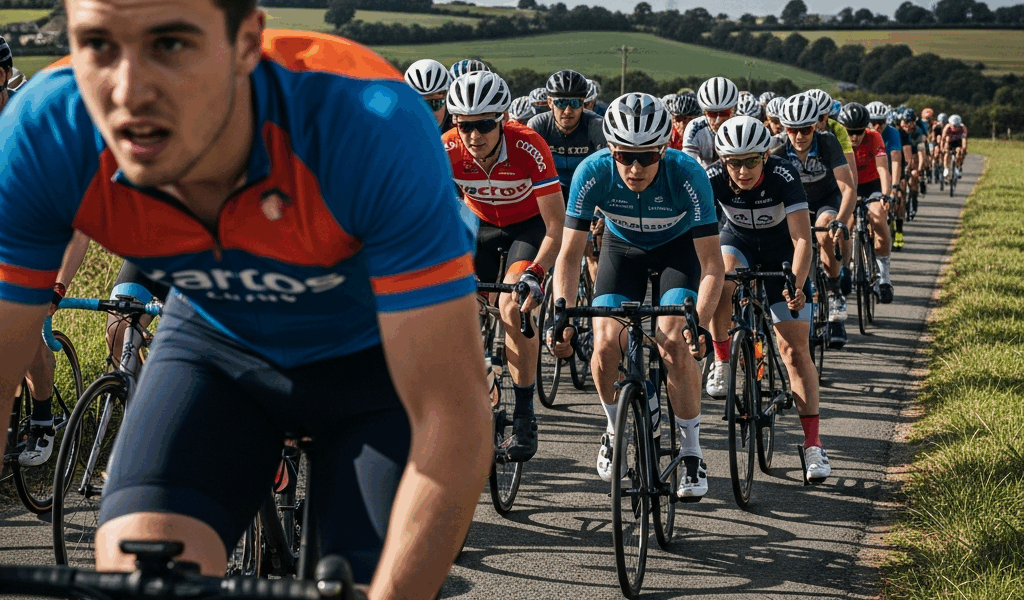
Staging opens about 15 minutes before your wave goes off. A referee or official will call your category to the line, check helmets, sometimes check brakes with a quick squeeze. Then you wait. Standing there clipped into your pedals with 40 strangers who are all trying to look confident. Nobody is confident. Some people are making small talk about gear ratios. Ignore them.
The start is signaled by either a whistle, a gun, or a referee counting down — varies by event. At that moment, approximately half the field tries to sprint to the front immediately. Do not be one of those people. Seriously. The first lap of a Cat 5 criterium is the most dangerous few minutes of the entire race. Everyone is nervous, nobody is reading the course well yet, and the pace swings wildly between way too fast and accordion-braking into corners.
Where to Position Yourself
Middle of the pack for the first lap. Not the back — the back gets dropped when the pace surges and you’ll spend the whole race chasing — but not the front either, where every attack and acceleration hits you directly. Middle gives you riders to watch, a natural speed buffer, and time to get comfortable with the pack before you need to make any real decisions.
Strangled by nerves at my second race, I let myself drift to the back of 60 riders on lap one and spent the next 25 minutes in no-man’s-land. Stay in the middle. Repeat this to yourself in the parking lot.
During the Race — Drafting, Corners, Feeding
Drafting is legal and expected. Sitting on someone’s wheel reduces your aerodynamic drag by roughly 25–30%, which means you can hold the same speed for significantly less effort. In a group, you’re drawing from that benefit constantly. The key is maintaining a consistent gap — about a half wheel to a full wheel behind the rider in front of you. Too close and you’re a collision risk. Too far and you’re doing extra work for no reason.
Hand Signals
You will hear people shouting and pointing during the race. Learn these before you line up:
- Hand down, pointing at the road — Hazard ahead. Pothole, gravel, debris. Point down and slightly to the side where the hazard is.
- Arm back, palm flat — Slowing down. Use this instead of sudden braking when you can.
- Arm extended to the side — Turning. Same as driving a car without turn signals, basically.
- “Car up” / “Car back” — A vehicle is approaching from the front or rear. Move to single file.
- “Hole!” — There is a pothole. Move.
Pass signals backward through the pack when you receive them. This is just courtesy and also keeps everyone from hitting the same pothole you saw three seconds ago.
Where Crashes Happen
Corners. Specifically, the exit of corners in the first few laps when the pack is tightest and everyone is still figuring out the course. If you’re new, take a slightly wider line through corners — it’s slower but much more predictable. Don’t overlap wheels with the rider in front of you. If they move and your front wheel is tucked behind their rear wheel, you go down. Full stop.
The other high-risk moment is feeding zones in longer road races. In Cat 5, these are rarely complicated — a musette bag handed up from a team helper or a simple bottle grab — but even a small fumble at speed creates chaos behind you. Practice grabbing a bottle from someone’s hand before race day. It feels stupid in your driveway but it matters.
Pacing and the Urge to Attack
You will feel, at some point in your first race, a sudden surge of adrenaline and the thought that you could probably go to the front right now. You might even be right. But unless you have a specific plan — a sprint finish you’re setting up for, a breakaway you’re responding to — stay patient. Burning matches early in a criterium leaves you with nothing for the final laps. Sit in, breathe, watch what the stronger riders do. Your first race is school. Treat it that way.
After You Finish — Results, Recovery, What Next
Results for most USAC races are posted within an hour of the finish, sometimes faster. They go up on the USA Cycling live results page at results.usacycling.org, and most promoters also post them on the event’s own website or Facebook page. Your finishing place, time gap, and upgrade points (if applicable) will all be listed.
How the Upgrade System Works
In Cat 5, you need 10 upgrade points to move to Cat 4. Points are awarded based on field size and finishing position — generally, you need a top-10 finish in a field of 30 or more to earn points, though the exact formula varies. Alternatively, you can upgrade after 20 mass-start races regardless of results. Most riders who are racing regularly move up to Cat 4 within a season.
The upgrade isn’t something you need to obsess over in your first race. Race five or six times in Cat 5, get comfortable with pack dynamics, work on your cornering, then start thinking about it.
Recovery After Your First Race
Even a 45-minute criterium will leave you more tired than a typical training ride of the same duration. Racing is different — the intensity is uneven, the stress response is real, and you’ve been holding tension in your hands and shoulders the whole time. Eat something real within 30 minutes of finishing. A Clif Bar and a banana is fine. A full meal is better. Hydrate even if you don’t feel thirsty.
Take a day or two easy after your first race. Not because you’ll be wrecked — you might not be — but because building the habit of actual recovery from the start is worth more than the extra miles you’d log by going out hard the next morning.
When to Do Your Next Race
As soon as possible, honestly. The second race is easier than the first in almost every way. You know the routine, you’ve seen a start, you have a feel for pack positioning. The anxiety drops sharply. Most people who do one race and wait three months to do another have to rebuild their comfort level from scratch. If you can race two or three weekends in a row, do it. The learning compounds fast.
Check BikeReg or your regional cycling association’s calendar for upcoming events. USA Cycling’s regional calendars are searchable by state at usacycling.org. Many areas have weekly Tuesday or Thursday night criteriums during summer that are perfect for getting reps in a low-stakes environment.
Your first race will be messy. You’ll make at least one decision you’ll second-guess in the car on the way home. That’s fine. Every experienced racer in that field was once the nervous person in the middle of the pack with too many gels and not enough safety pins. Go do it. The rest figures itself out.


Stay in the loop
Get the latest cycling events today updates delivered to your inbox.