
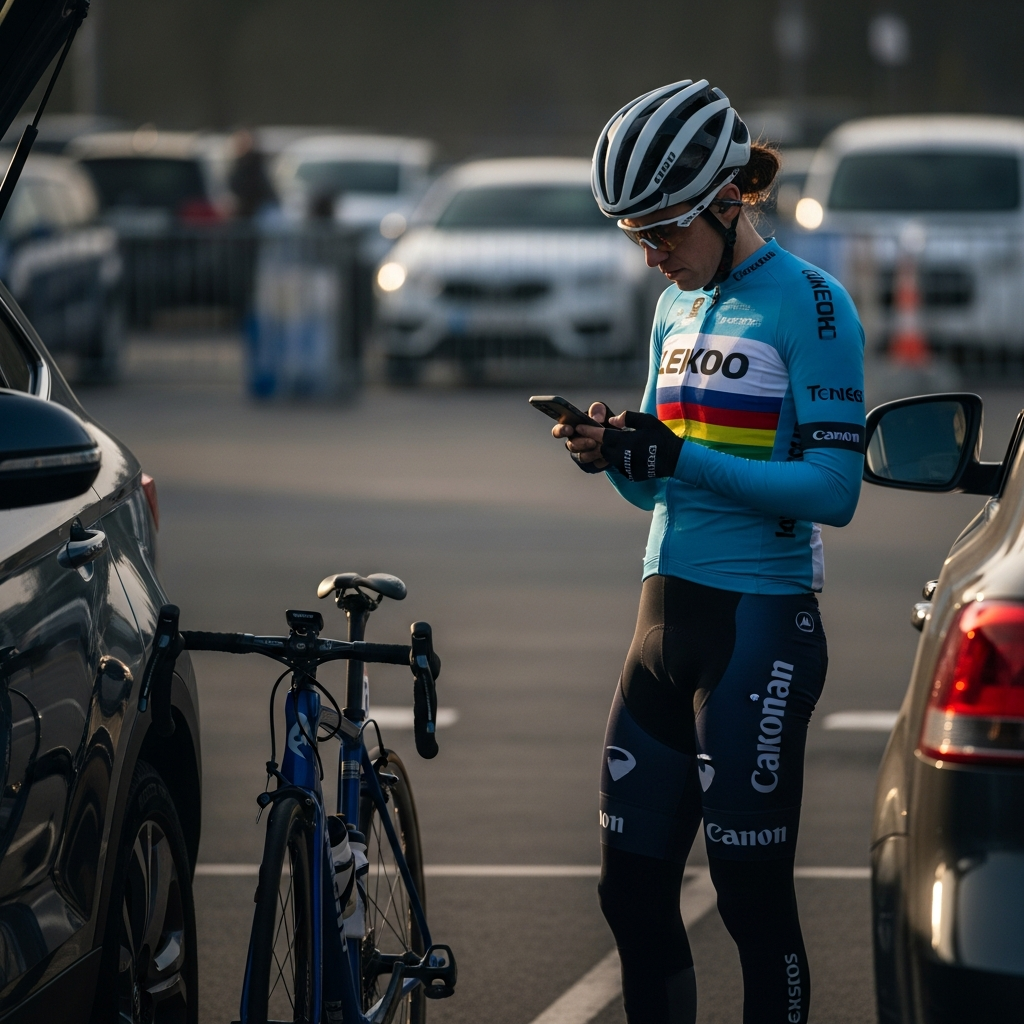
You’re still pinning your number in the parking lot when you hear the announcer call your category to the line. The schedule you screenshotted on Wednesday said your wave rolled at 9:40. It’s 9:12, and the officials moved everything up half an hour because a thunderstorm cell is tracking toward the venue. You sprint to staging with one glove on and start the day already in the red.
Anyone who races more than a couple of times a season has lived some version of this. The hard part of event day usually isn’t the effort — it’s the logistics around the effort, and the single most fragile piece is knowing exactly when your start actually happens. That number moves more often than riders expect, and the place most of us store it is a screenshot that can’t update.
Race schedules are moving targets
A published start list is a plan, not a promise. Weather holds push a crit back forty minutes. A crash on course stretches the gap between waves. Officials consolidate thin fields, so the Cat 4/5 race you expected at 11 suddenly goes off at 10:20. Stage races and gravel events with multiple distances are the worst offenders — a single delay early in the day ripples through every category behind it.
The information does get updated. It goes up on the timing company’s page, or the promoter’s social feed, or a printout taped to the registration tent. What it almost never does is reach back into the plan you actually made — the alarm you set, the screenshot in your camera roll, the start time you told your ride to expect. So you operate on stale data right up until the moment you discover it’s wrong, usually at the worst time.
Sync the schedule to your calendar
A cleaner approach is to keep your start time somewhere that can actually change when the race does — your calendar. A service called LiveCal is built for this exact pattern of live, schedule-driven events. You tell it the event you’re tracking, it confirms a live data feed exists, and it places your start on your Google Calendar as a real event — then patches that event in place as the schedule shifts. You’re not chasing a social feed for updates; the time on your calendar simply stays correct.
For race day that’s the difference between a screenshot and a living plan. If officials move your wave up because of weather, the start on your calendar moves with it, and the warm-up alarm you anchored to that event shifts too. Because it writes to the Google Calendar you already use, your start sits next to your drive time and your post-race plans, so the whole day reflows around the new number instead of falling apart over it.
Setting it up for your race season
The habit worth building is front-loading the season. When you register for an event, add its schedule as a tracked calendar entry right then, while you’re already looking at the details. Anchor your own routine to that event rather than to a fixed clock time — warm-up ninety minutes before the start, leave the house three hours before, kit check the night before. When the start time updates, everything pinned to it travels along, and you never have to recompute the morning’s timeline by hand.
This matters even more across a multi-race weekend or a season with overlapping disciplines. Road on Saturday, gravel on Sunday, a midweek crit series — when each start lives as a self-updating event, your calendar becomes the one honest view of when you actually need to be where. No cross-referencing three timing pages, no mental math at 6 a.m. in a parking lot.
What still belongs in the rider meeting
Automation handles the clock, not the context. Course changes, neutral rollout details, last-minute rule calls, and the exact staging order are things you still get from the rider meeting and the officials — show up, listen, and confirm. A live calendar entry is there to make sure you’re standing in staging at the right minute, fully warmed up, instead of sprinting from the car with one glove on. It removes the logistics scramble so your attention is free for the part that actually decides your day.
The riders who always seem unhurried on the start line aren’t lucky with the schedule. They’ve just stopped trusting a screenshot to track a number that keeps moving. Put your start time somewhere that updates itself, and the most stressful part of race morning quietly takes care of itself.


Stay in the loop
Get the latest cycling events today updates delivered to your inbox.